- What is Kimi K3?
- Key Highlights of Kimi K3
- 1. Kimi Delta Attention (KDA) and Attention Residuals (AttnRes)
- 2. 1-Million-Token Context Window
- 3. Native Multimodality
- 4. K3 Agent Swarm — Parallel Agent Execution
- Benchmark Performance
- Superior Coding Capabilities
- GPU Kernel Optimization
- Compiler Construction from Scratch
- Autonomous Chip Design
- Knowledge Work and Creativity
- Interactive Research
- Professional Video Editing
- Widgets and Dashboards
- Pricing and Accessibility
- Open Weights and Roadmap
- Limitations to Note
- Conclusion
What is Kimi K3?
Kimi K3 is the latest large language model (LLM) from Moonshot AI, a leading Chinese AI startup founded by alumni of Tsinghua University. The core differentiator of K3 over previous generations lies in its Mixture of Experts (MoE) architecture, featuring a total of 2.8 trillion parameters. At each computation step, only 16 out of 896 experts are activated thanks to the Stable LatentMoE framework.
The model is optimized for three critical domains:
- Software engineering — long-horizon coding, system optimization
- Knowledge work — research, analysis, complex information synthesis
- Deep reasoning — multi-step logical problem solving
Key Highlights of Kimi K3
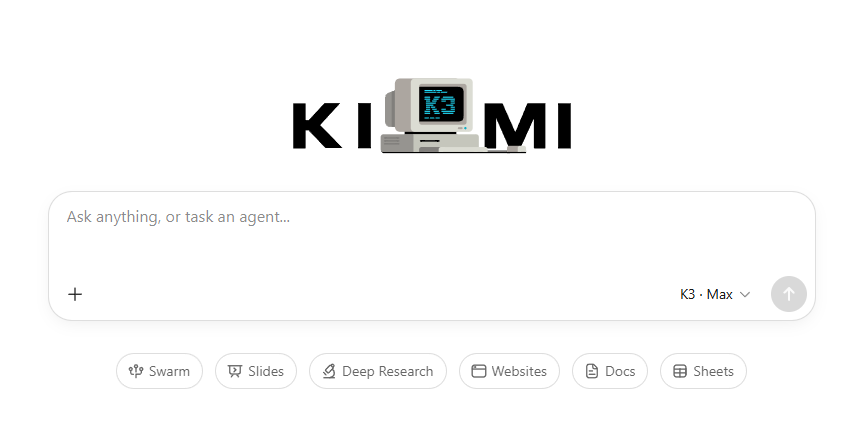
1. Kimi Delta Attention (KDA) and Attention Residuals (AttnRes)
Two groundbreaking architectural innovations give Kimi K3 its superior performance and efficiency:
- Kimi Delta Attention (KDA): A highly efficient foundation for scaling attention mechanisms, significantly reducing memory requirements and accelerating decoding speed by up to 6.3x in million-token contexts.
- Attention Residuals (AttnRes): Enables the model to selectively retrieve representations across deep layers rather than accumulating them uniformly, yielding approximately 25% higher training efficiency with less than 2% additional compute overhead.
Combined with techniques such as Quantile Balancing (percentile-based expert balancing), Per-Head Muon (independent attention head optimization), and Sigmoid Tanh Unit (SiTU), Kimi K3 achieves scaling efficiency approximately 2.5x that of the Kimi K2 generation.
2. 1-Million-Token Context Window
With the ability to process contexts of up to 1 million tokens, Kimi K3 can ingest entire large codebases, thousands of pages of documents, or long videos in a single session. This is particularly crucial for long-horizon agent tasks, legal document analysis, and large-scale academic research.
3. Native Multimodality
Kimi K3 does not merely understand text — the model processes images, video, and text within a single unified architecture. Its “vision in the loop” capability enables K3 to seamlessly iterate between writing code and analyzing real-time screenshots, optimizing web interfaces, developing 3D games, and designing CAD models.
4. K3 Agent Swarm — Parallel Agent Execution
The breakthrough K3 Agent Swarm feature allows deploying large numbers of AI agents working in parallel, combining broad search, deep research, large-scale analysis, long-form writing, and multi-format content generation. Agents collaborate effectively to complete end-to-end deliverables across websites, documents, slides, and spreadsheets in a single run.
Benchmark Performance
Kimi K3 delivers impressive results across multiple standardized tests:
| Benchmark | Kimi K3 (max) | Claude Fable 5 | GPT 5.6 Sol |
|---|---|---|---|
| GPQA-Diamond | 93.5 | 92.6 | 94.1 |
| MMMU-Pro | 81.6 | 81.2 | 83.0 |
| MathVision | 94.3 | 94.8 | 95.8 |
| MathVision + Python | 97.8 | 98.6 | 97.8 |
| OmniDocBench | 91.1 | 89.8 | 85.8 |
| SpreadsheetBench 2 | 34.8 | 34.7 | 32.4 |
Notably, Kimi K3 has surged to #1 at Frontend Code Arena with 1,679 points, surpassing Claude Fable 5 — a remarkable 17-position leap from Kimi K2.6 (which ranked #18).
Superior Coding Capabilities
GPU Kernel Optimization
In GPU kernel optimization tests, Kimi K3 has:
- Designed a novel two-phase kernel algorithm, reducing AttnRes forward+backward time from 283.6 ms to 114.4 ms
- Cut 55.1% of end-to-end DSA kernel time in 1-million-token training contexts
- Achieved 517.8 TFLOPS on the MLA-512 kernel, outperforming the second-best model (492.7 TFLOPS)
Compiler Construction from Scratch
Kimi K3 developed MiniTriton — a Triton-like compiler featuring a tile-level IR layer, optimization passes, and a PTX code generation pipeline. MiniTriton matches or exceeds Triton and torch.compile performance across multiple workloads, while maintaining stable end-to-end nanoGPT training.
Autonomous Chip Design
In a stunning proof-of-concept, Kimi K3 designed a nano-model serving chip based on its own architecture. Over 48 hours of autonomous operation, K3 built, optimized, and verified the chip using open-source EDA tools. The 4 mm² chip achieves 100 MHz frequency, 8,700+ tokens/second decode throughput, with 1.46 million standard cells and an INT4 MAC array.
Knowledge Work and Creativity
Interactive Research
Kimi K3 can generate interactive research reports from thousands of data sources. A standout example: a 42-year history of the AI ASIC industry, created through 120+ recursive self-improvement rounds, pulling data from 2,800+ web searches and 1,100+ terminal retrievals, spanning 11,000+ pages from 87 quarterly reports and 99 source PDFs.
Professional Video Editing
Kimi K3 can edit videos from dozens of source clips, handling clip selection, motion-matched cutting, frame-accurate rhythm synchronization, audio processing, and multiple editing rounds. A short, high-complexity video like this would typically require a professional editor 1-2 days of work.
Widgets and Dashboards
Two new features in Kimi Work enable creating interactive components directly within chat, connecting local data or external plugins. Dashboards aggregate the most important widgets into a personalized, continuously updated view.
Pricing and Accessibility
Kimi K3 is available through multiple channels at competitive pricing:
| Request Type | Price (USD/MTok) |
|---|---|
| Input (cache hit) | $0.30 |
| Input (cache miss) | $3.00 |
| Output | $15.00 |
Thanks to the Mooncake distributed inference architecture, the official API achieves cache hit rates above 90% in coding workloads, significantly reducing real-world costs.
Access channels:
- Kimi.com — Web chat
- Kimi App — iOS, Android, HarmonyOS
- Kimi Work — Desktop app (Windows, macOS Apple Silicon)
- Kimi Code — CLI with
/modelcommand - Kimi API Platform — Application integration
- AWS Marketplace — Centralized enterprise billing
Open Weights and Roadmap
Moonshot AI is committed to the open-source community. The full Kimi K3 model weights will be released on July 27, 2026. A detailed technical report covering architecture, training, and evaluation will also be published at the same time. Moonshot AI has already contributed the KDA implementation with prefix caching to the vLLM community.
Limitations to Note
Despite being a highly competitive model, Kimi K3 has some limitations:
- Sensitivity to thought history: K3 is trained with a thought-retention mode. If the agent system does not pass the full thought history, generation quality may become unstable.
- Over-proactivity: Due to its focus on difficult long-horizon tasks, K3 may make unexpected decisions when encountering minor issues or ambiguous user intent.
- User experience gap: While overall performance is excellent, K3 still has a noticeable user experience gap compared to Claude Fable 5 and GPT 5.6 Sol.
Conclusion
Kimi K3 marks a historic milestone in open-source AI — the first time a nearly 3-trillion-parameter model has been released openly. With its advanced KDA and AttnRes architecture, native multimodal capabilities, million-token context window, and top-tier coding performance, Kimi K3 is not just a tool but a platform for the next generation of autonomous AI agent applications.
For developers, researchers, and enterprises seeking frontier-grade AI solutions at reasonable cost with deep customization potential, Kimi K3 is an unmissable choice in 2026.







Comments